Best Power Inverters for Cars: Top 5 in-Car Models for on-the-Go Power 2026
Looking for reliable power in your vehicle? This guide highlights the best power inverters for cars, helping you choose devices that convert 12V DC to 110V AC with USB charging options. Ideal for road trips, camping, work on the go, and emergency use. The top picks below are suited for travelers, commuters, and families who need to run small appliances or charge multiple devices in the car.
| Product | Why It’s a Pick |
|---|---|
| Pro Chaser 400W Power Inverter (Vehicle) — 12V to 110V | Best overall versatility with dual AC outlets and fast USB charging for multiple devices. |
| BESTEK 300W Car Power Inverter — 12V to 110V | Better for long trips thanks to compact design and solid USB/AC output balance. |
| YSOLX 300W Car Power Inverter — 12V to 110V | Great for outdoor use with multiple ports and robust cooling features. |
| EPANEE 400W Car Power Inverter — 12V to 110V | Strong continuous and peak power with built-in safety features for longer use. |
| vansoet 400W Car Power Inverter — 12V to 110V | High versatility with PD USB-C and multiple USB ports plus independent AC control. |
Pro Chaser 400W Power Inverter — 12V to 110V
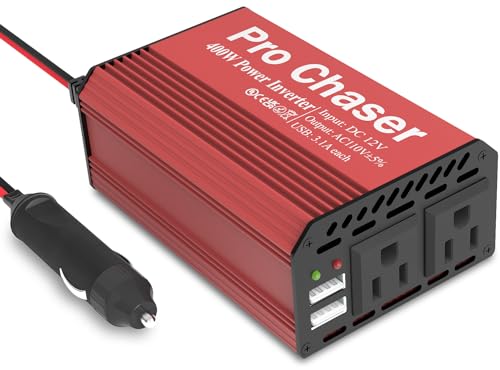
Power and portability define this model. It delivers 400W continuous power with up to 800W peak, with two 110V AC outlets and USB ports for quick charging. Best for road trips where laptops, tablets, cameras, and small appliances must stay powered.
- Best for: Road trips, family travel, on-the-go charging of laptops and devices.
- Why selected: Balanced AC outlets and USB charging in a compact, easy-to-handle unit.
- Caution: Avoid running high-wattage appliances near the upper limit of its continuous rating for extended periods.
BESTEK Power Inverter DC 12V to AC 110V — 300W
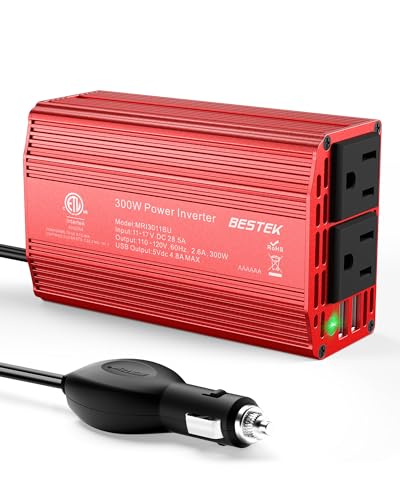
The BESTEK unit emphasizes a compact, lightweight design with dual 110V outlets and two USB ports. It’s a solid pick for travelers who need reliable power for laptops and larger devices without adding bulk.
- Best for: Travelers who value a slim profile and steady output for laptops and tablets.
- Why selected: Patented tech from a leading brand offers dependable performance in a portable form.
- Caution: The compact case can warm up with heavy loads—allow cooling time between high-demand uses.
YSOLX 300W Car Power Inverter — 12V to 110V

This inverter suits outdoor enthusiasts and campers. It provides 300W continuous power with four USB ports and dual 110V outlets, supporting devices from smartphones to small kitchen gear.
- Best for: Camping, outdoor adventures, and extended road trips with multiple USB devices.
- Why selected: Emphasizes cooling and multiple ports to handle several devices simultaneously.
- Caution: Higher-watt appliances may approach its continuous rating; plan usage accordingly.
EPANEE 400W Power Inverter — 12V to 110V

EPANEE combines robust power with built-in safety protections. It delivers 400W continuous power with dual 110V outlets and USB-C PD plus USB-A QC ports for fast charging and efficient power management during longer trips.
- Best for: Users needing stronger continuous power with modern fast-charging options.
- Why selected: Includes intelligent cooling and a fuse-based protection system to support safe operation.
- Caution: Internal temperature management relies on a fan; expect occasional noise during heavy use.
vansoet 400W Car Power Inverter — 12V to 110V

This model emphasizes versatility with a dedicated AC control switch and PD 30W USB-C plus additional USB-C and USB-A ports. It is well-suited for users who want flexible power distribution from a single device.
- Best for: Road trips requiring controlled use of AC outlets and fast USB-C charging.
- Why selected: Independent AC control helps save energy and makes sharing outlets easier in the car.
- Caution: Higher power loads may require careful management to avoid tripping the built-in protections.
Buying Guide: Power Inverters For Cars
Key considerations help pick the right inverter for your vehicle and devices.
- Power needs: Match continuous wattage (W) to the sum of your devices’ running power. If you plan to run laptops or small appliances, choose at least 300–400W with some headroom for peak loads.
- Outlets and ports: Look for dual AC outlets if you need to power more than one device simultaneously. USB-C PD ports are helpful for newer laptops and phones; USB-A ports cover older devices.
- Portability: A compact, car-friendly size makes it easier to store and use on the go, especially in smaller vehicles.
- Cooling and safety: Built-in fans and fuse protection reduce overheating and short-circuit risks. Check for over-voltage and over-temperature protections.
- Contact options: A longer cord (around 30 inches) can improve flexibility for passenger seating and load placement inside the car.
- Use case: Choose a model that balances continuous power with peak support. Consider a unit that can handle a laptop, CPAP, or small DVD player if needed.
Frequently Asked Questions
- What is a car power inverter?
An in-car power inverter converts DC power from your vehicle’s battery to AC power, letting you run small appliances and charge devices while you travel.
- How many watts do I need for a laptop?
Most laptops require 60–180W while charging; choose an inverter that provides at least 300W continuous power to cover laptop use plus accessories.
- Can I run high-wattage devices in a car inverter?
Yes, but ensure the device’s running wattage stays within the inverter’s continuous rating and leave headroom for peak power.
- Is USB-C PD faster for charging devices in a car?
Yes, USB-C PD ports deliver higher wattage and can fast-charge compatible laptops and devices compared to standard USB ports.
- Should I worry about safety when using an inverter?
Look for built-in protections such as short-circuit and over-temperature safeguards, and avoid running devices that exceed the inverter’s ratings for long periods.
- How should I place an inverter in the car?
Place it in a ventilated area away from the driver’s feet, ensure cords are tucked to prevent accidental disconnection, and avoid blocking airbags or controls.