Best Rust Treatment for Cars: Top 5 Options for Long-Lasting Protection 2026
Answering the typical buyer question: which rust treatment is best for a car depends on your rust stage and goal. For existing rust, consider a converter or remover; for preventive protection, a corrosion inhibitor or stopper works well. This guide highlights five reliable options that suit common automotive needs, from converting rust to applying protective coatings. Best picks include converters for salvageable metal, surface reformers for immediate priming, and inhibitors for ongoing protection. The following table summarizes the top choices and their optimal use cases.
| Product | Best For | Why Best |
|---|---|---|
| Rust-Oleum Stops Rust Reformer Spray Paint | Converting rust to a paintable surface | Instant rust conversion with a paintable, protective finish |
| STA-BIL Rust Stopper | Preventing new rust on exposed metal | Corrosion inhibitor with battery terminal protection |
| Rust-Oleum Rust Dissolver Gel | Removing rust efficiently from tools and small parts | Dissolves rust with no scrubbing |
| Corroseal Rust Converter & Metal Primer | Full rust conversion and priming in one step | Water-based, non-flammable rust stop and primer |
| 2 in 1 Rust Converter & Metal Primer (Meuvcol) | High-performance rust encapsulation | Single-component protection across automotive surfaces |
Rust-Oleum 248658 Stops Rust Reformer Spray Paint

Rust-Oleum Stops Rust Reformer converts surface rust into a neutral, paintable layer that resists future corrosion. The oil-based formula bonds with the rusted surface, enabling a solid base for topcoat applications. Dries tack-free in 20-40 minutes, with full cure typically within 24 hours before topcoating. Best for: DIY enthusiasts who want an immediate, paint-ready surface on mildly rusted areas. Caution: may require proper ventilation due to solvent fumes; ensure surface is clean before application.
STA-BIL Rust Stopper
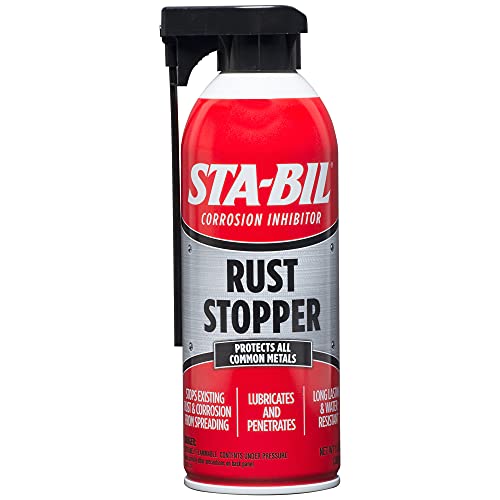
STA-BIL Rust Stopper combines a corrosion inhibitor with protective lubrication. It fights rust formation on exposed or painted metal surfaces and helps protect battery terminals from corrosion. The formula is water-resistant and designed to endure weather exposure, improving protection in rust-prone environments. Best for: ongoing preventive maintenance on metal components and battery terminals. Limitation: not a rust remover; it creates a protective layer to slow rust progression.
Rust-Oleum Rust Dissolver Gel

Rust-Oleum Rust Dissolver Gel clings to rusted areas on metal surfaces and dissolves rust quickly, typically in 10–30 minutes. It’s designed for heavy rust on tools, cars, bikes, grills, bolts, and more. No scrubbing is required—rinse and wipe to reveal a smooth surface ready for priming or painting. Best for: removing moderate rust from larger or stubborn spots without mechanical effort. Caution: may require multiple applications for heavily corroded areas.
Corroseal Rust Converter & Metal Primer
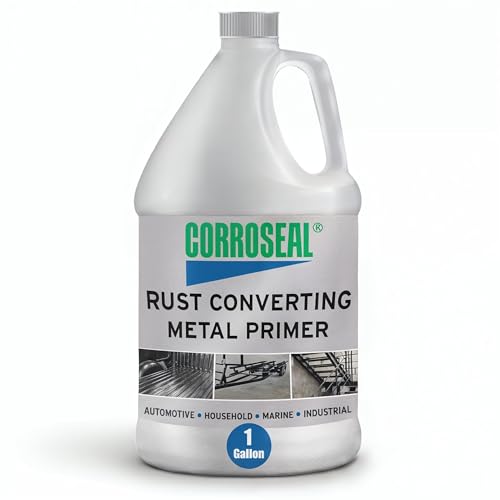
Corroseal converts rust and primes in one step with a water-based formula that cleans up with soap and water. It stops rust and provides a latex-based primer that helps restore metal surfaces. Best for: projects where a combined converter and primer are desirable, including automotive, industrial, and marine applications. Limitation: may require full coverage and adequate ventilation during application.
2 in 1 Rust Converter & Metal Primer (Meuvcol)

Meuvcol offers a high-performance rust converter that encapsulates and seals metal surfaces, with heat resistance up to high levels and broad applicability across automotive and industrial settings. Best for: professional-grade Rust encapsulation across frames, chassis, and structural components. Limitation: as a heavy-duty product, it may require proper surface preparation and curing time for optimal results.
Buying Guide: Key Considerations For Car Rust Treatments
- Rust stage: Is the metal surface flaky, pitting, or solid without exposed metal? Choose a remover or converter accordingly.
- Application area: Do you need surface treatment on the frame, body panels, or small parts? Some products are better for large areas, others for precise spots.
- Primer and topcoat compatibility: Will you topcoat after treatment? Ensure the product provides a paintable or primed surface suitable for your finish.
- Preventive vs. restorative: For ongoing protection, inhibitors and sealants help prevent future rust; for existing rust, converters or removers are preferred.
- Safety and handling: Many rust products are solvent-based or require ventilation. Follow label directions and use appropriate PPE.
- Surface prep: Most products require cleaning, removing loose rust, and drying before application to maximize adhesion and effectiveness.
Frequently Asked Questions
- What is the difference between a rust converter and a rust remover?
– A rust converter chemically neutralizes rust and converts it into a stable layer; a rust remover actually dissolves or scrapes away rust to expose clean metal. - Can I use rust treatment directly on automotive sheet metal?
– Yes, many products are designed for automotive use, but follow product guidelines for film formation and primer compatibility. - Do these products require topcoats?
– Some do; many reformers provide a paintable surface that accepts topcoats, while others create a standalone protective layer. - Is there any safety concern with spray-on rust products?
– Ventilate the work area, wear gloves and eye protection, and follow label instructions to avoid fumes or skin irritation. - Which option is best for battery terminals?
– STA-BIL Rust Stopper is specifically noted for battery terminal protection and corrosion prevention. - How long should I wait before applying a topcoat after using a rust reformer?
– Allow the product to dry per label instructions, often 24 hours or as specified, before applying topcoat.