Best Solar Panels for Cars: Portable 12V Chargers and Maintainers 2026
Direct answer: for most car owners, a compact 12V solar panel charger or maintainer is best when it combines portability, smart charging, and reliability. This guide compares five top car-friendly solar kits to help you choose the right one for daily use, road trips, or occasional maintenance. Ideal buyers include boaters needing lightweight portability, RV travelers seeking upkeep between charges, and car owners who want easy, no-drill installation. The table below summarizes the five products selected for versatility, durability, and ease of use.
| Product | Best For |
|---|---|
| Renogy 100W Flexible Panel | Curved surfaces; high power on boats, RVs, cabins |
| FlexSolar 20W Flexible Kit | Budget-friendly, flexible mounting; everyday cars |
| Voltset 20W MPPT Kit | Faster charging; all 12V batteries |
| SOLPERK 20W with MPPT | Durable, weatherproof; multi-battery types |
| SUNER POWER 50W Pro | Higher capacity for larger setups; long trips |
Notes: This article presents objective comparisons based on the listed features. Each product section explains who it’s best for and why it was selected, including any limitations or cautions grounded in the provided data.
Renogy 100W Flexible Panel For Vehicles
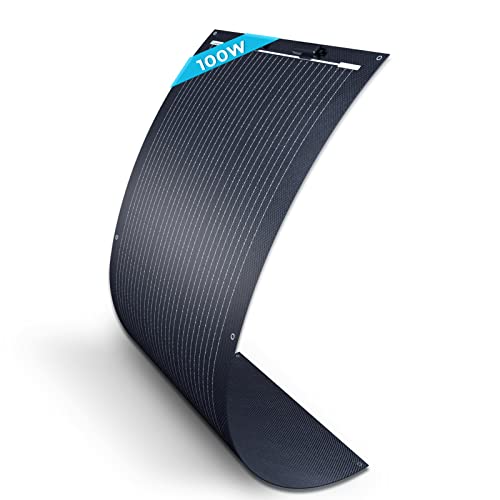
Best for curved surfaces and high power output. This 100W flexible panel uses half-cut PERC cell technology to improve efficiency and energy capture, making it suitable for boats, vans, and RV exteriors. The ultra-lightweight design reduces weight while delivering substantial daily output in sunny conditions. Best for buyers who need a high-capacity, adaptable panel that can conform to non-flat surfaces. A potential limitation is the higher upfront cost relative to smaller kits, which may be overkill for simple battery maintenance.
FlexSolar 20W 12V Trickle Charger Kit

Best for budget-conscious buyers who want plug-and-play versatility. The kit provides four connection options (cigarette lighter, alligator clips, OBDII, ring terminals) and a built-in charge controller for cars, boats, and motorcycles. Its 20%–25% efficiency monocrystalline core offers solid performance for maintaining batteries and topping off in sunny conditions. Caution: the compact 20W rating means slower charging on larger battery banks or during extended cloudy periods.
Voltset 20W MPPT Solar Charger Kit

Best for faster charging and universal battery compatibility. Its MPPT controller claims 20–30% faster charging, with smart protection against overcharge, over-discharge, short circuits, and reverse polarity. Suitable for cars, RVs, boats, and trailers that rely on 12V batteries, including LiFePO4 and lithium-ion variants. Limitation: as a 20W kit, it won’t deliver high power in low-sun conditions or charge very large batteries quickly.
SOLPERK 20W Solar Panel Kit with MPPT
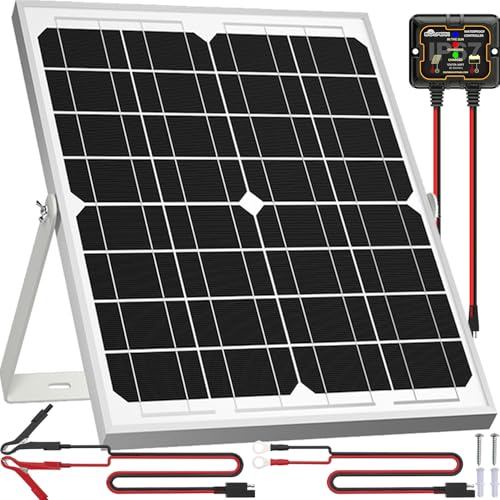
Best for rugged, all-weather installations. The kit features a robust low-iron tempered glass panel and corrosion-resistant aluminum frame, with an MPPT controller that claims 20–30% higher charging efficiency than many rivals. It supports various 12V battery chemistries and emphasizes durability for boats, RVs, and farm equipment. Limitation: maximum 20W output means it’s best for battery maintenance rather than rapid charging in large battery banks.
SUNER POWER 50W Pro Solar Charger

Better for larger battery banks and longer trips. This 50W panel utilizes Ultra-Smart MPPT for high tracking efficiency and a three-stage charging algorithm to optimize battery health. It stops charging when full and resumes automatically when the battery discharges. Suitable for cars with larger electrical needs, RVs, boats, and trailers. Caution: requires more mounting space and may be heavier than smaller 12V kits.
Buying Guide
What should you consider when choosing a car solar panel kit?
- Power needs: Small 12V trickle chargers (5–20W) are ideal for battery maintenance and slow topping off. Higher outputs (50W+) suit larger systems or frequent use on longer trips.
- Flexibility vs fixed: Flexible panels conform to curved surfaces, while rigid panels may be sturdier for stationary setups. Choose based on your mounting area and application.
- MPPT vs PWM: MPPT controllers extract more energy, especially in partial sun, but add cost. PWM is simpler and adequate for basic maintenance on small systems.
- Battery compatibility: Ensure the kit supports your battery type (AGM, LiFePO4, flooded, etc.). Some chargers explicitly cover multiple chemistries.
- Durability and weatherproofing: Look for tempered glass, rust-resistant frames, and waterproof seals if you’ll expose panels to the elements.
- Installation ease: Kits with cigarette-lighter connections and included mounting hardware simplify quick setup, especially for portable use.
- Portability vs performance: If you need a panel on the go, prioritize light weight and compact form; for frequent camping or boating, higher power and robust mounting matter more.
FAQ
- What is the difference between MPPT and PWM controllers?
- Can a 12V solar panel charge a car battery?
- Is a flexible panel better than a rigid panel for cars?
- Do these kits work in cloudy weather?
- Which kit is best for RV use?
MPPT controllers maximize energy extraction by adjusting the voltage to match the panel’s optimal point, offering higher efficiency, especially in variable sunlight. PWM controllers are simpler and usually cheaper, suitable for small, steady loads.
Yes. A 12V panel can maintain or slowly recharge a car battery, especially when connected through a suitable charge controller and during sunny conditions.
Flexible panels are better for curved surfaces and lightweight applications, while rigid panels can be more durable and easier to mount on flat rooftops.
Yes, but output is reduced. Higher-efficiency modules and MPPT controllers help maximize charging under sub-optimal light, though performance will still lag a sunny day.
For RVs requiring more power, the higher-capacity SUNER POWER 50W Pro or the Renogy 100W flexible panel is well-suited, depending on available mounting space and battery bank size.