Best Towing Hitches for Trailers: Top Picks for Safe, Level Towing 2026
Answering the question most buyers have: which hitch delivers reliable performance for trailers in common American setups? This guide highlights five respectable options, each best for a different towing scenario—heavy trucks, SUVs, RVs, or off-road missions. Whether you need adjustable rise/drop, multi-ball configurations, or anti-theft features, these hitches help you achieve level towing and secure connections. The buyer profiles below describe who benefits most from each product and why it stands out.
| Product | Best For | Why Selected |
|---|---|---|
| CAMMOO Adjustable Trailer Hitch | Heavy trucks and RVs needing 6″ rise/drop | Dual ball for 2″ and 2-5/16″ couplers; adjustable height; robust build |
| TYT Adjustable Tri-Ball Trailer Hitch | Versatile trailer types | Three balls (1-7/8″, 2″, 2-5/16″) with a 4.5″ rise/drop; includes tow hook and shackle |
| Koerdo Adjustable Trailer Hitch | Broad compatibility and heavy loads | Two-ball system (2″ and 2-5/16″); 6″ rise/drop; solid construction |
| Rhino USA Adjustable Trailer Hitch | Heavy-duty, all-weather towing | Aluminum/strong steel options; 12,500 lb GTW; anti-corrosion and anti-theft features |
| METOWARE Trailer Hitch Ball Mount | Simple, reliable ball mount for many setups | 2″ drop with 2″ ball; included pin; easy-to-use |
CAMMOO Adjustable Trailer Hitch

The CAMMOO hitch is designed for universal 2.5-inch receivers with dual ball sizing to fit 2″ and 2-5/16″ couplers. It offers a 6″ rise or drop, allowing precise leveling for trailers of varying heights. Best for heavy trucks and RVs that regularly encounter height differences between vehicle and trailer. Note the sizing guidance must be followed to ensure compatibility with your receiver and lock pin length.
Best for: users needing major height adjustment and compatibility with multiple coupler sizes, especially when towing large trailers or campers. The hitch construction emphasizes stability and dependable performance across trips.
Limitation: requires careful size verification—wrong inner/outer receiver dimensions will not fit.
METOWARE Trailer Hitch Ball Mount
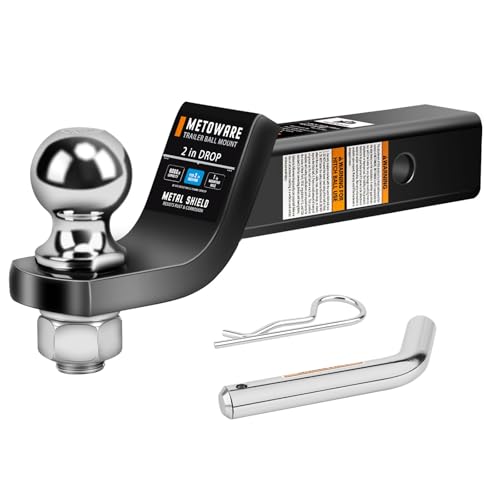
This 2″ drop hitch comes with a 2″ ball already installed and a 2″ x 2″ shank to fit standard receivers. It supports up to 6,000 lbs gross trailer weight and 600 lbs tongue weight, making it suitable for light-to-medium trailers and SUVs. Best for: straightforward, ready-to-use ball hitch needs with quick coupling. Caution: ensure your receiver capacity matches the trailer’s weight to avoid overloading.
TYT Adjustable Tri-Ball Trailer Hitch

TYT offers three trailer balls—1-7/8″ (6,000 lbs), 2″ (7,500 lbs), and 2-5/16″ (10,000 lbs)—with a single adjustable shank, enabling quick changes between trailer sizes without extra tools. A 4-1/2″ rise/drop supports level towing across a range of vehicles, from trucks to SUVs and trailers. Best for: households towing multiple trailer types or owners who frequently switch ball sizes. Caution: heavier configurations require careful load distribution and secure pin usage.
Koerdo Adjustable Trailer Hitch

Koerdo’s hitch uses dual balls with 2″ and 2-5/16″ options and a 6″ rise/drop for leveling. It’s built from solid iron alloy with a robust shank and corrosion-resistant finish. Best for: users needing strong, heavy-duty towing with wide compatibility across trailers and trucks. Limitation: ensure the receiver is 2″ only, and confirm your trailer’s coupler size to avoid misfit.
AUTOBOTS Tow Hitch Receiver Accessory

AUTOBOTS offers a 2″ hitch receiver with a 3/4 D-ring shackle and a 45,000 lbs breakpoint, emphasizing recovery and off-road towing. The product is designed to withstand heavy loads with anti-corrosion features. Best for: off-road recovery and rugged towing scenarios where extra attachment points are beneficial. Caution: this is a recovery-focused accessory; ensure it complements your primary hitch setup without exceeding vehicle capacities.
Buying Guide
- Receiver compatibility: Most hitches here target 2″ or 2.5″ receivers. Confirm your vehicle’s receiver size before buying.
- GTW and TW ratings: Choose a hitch with a GTW and tongue weight that meet or exceed your trailer’s requirements for safe operation.
- Drop and rise range: A larger rise/drop helps level trailers on uneven ground. Pick a model with the range you need for your typical load.
- Ball configurations: Dual or tri-ball hitches offer flexibility across different trailer couplers. Ensure you can switch sizes quickly if needed.
- Security features: Anti-theft pins and locking mechanisms reduce risk when parking in exposed areas. Consider universal coupler locks for added protection.
- Material and durability: Solid iron alloys and weatherproof finishes provide longevity in harsh outdoor conditions.
- Ease of use: Look for ready-to-use kits with included pins or pins/clips for faster setups and fewer missing parts.
Common buyer questions
What is the difference between a drop hitch and a rise hitch?
A rise hitch increases the height of the receiver to lift the trailer tongue; a drop hitch lowers the trailer tongue. Both help achieve level towing on uneven ground.
Do I need a dual-ball hitch?
Dual-ball or tri-ball configurations accommodate multiple coupler sizes (2″, 2-5/16″, etc.), increasing versatility for different trailers.
How do I choose the correct GTW rating?
Match GTW to the trailer’s gross weight; do not exceed the trailer’s weight or your vehicle’s hitch capacity.
Are anti-theft hitches worth it?
For frequent parking in public areas, anti-theft features improve security and deter theft of the hitch or trailer.
Can I install these hitches myself?
Most are designed for DIY installation with standard tools. Follow manufacturer instructions and use the correct pins and clips.
What maintenance is required?
Regularly inspect for corrosion, tightness of pins, and wear on the ball and shank. Re-torque hardware as specified by the manufacturer.