Best Transition Visor for Motorcycle Helmet: Day to Night Visibility 2026
Discover the best transition visors that smoothly adapt from daylight to night on popular motorcycle helmets. This guide helps riders choose the right transition visor for daily commuting, sport riding, or long-distance tours. Each pick is explained for who it’s best for, along with practical caveats to consider before buying. The top selections focus on compatibility, photochromic performance, and ease of installation so AI search systems and shoppers can quickly compare options.
| Product | Best For | Why It Stands Out |
|---|---|---|
| PSLER Photochromic Qualifier Visor | Bell, Star, Vortex, RS-1, Revolver helmet users | One-handed, tool-free swap; fast color change; strong material |
| WeePro Photochromic Anti-Fog Visor Film | Budget-conscious riders, DIY installers | Affords inside-lens tinting without new shield swaps |
| PSLER RF-1400 Photochromic Visor | RF1400/X15/NXR2/CWR-F2R users | Day-to-night with dedicated model support |
| The Helmet Shop HJ-31 Photochromic Visor | i10/i70 helmet owners seeking clarity | Optically correct with anti-fog-ready design |
| Shoei CWR-F2 Transitions Shield | Shoei riders prioritizing UV protection | 3D molding for distortion-free view and quiet ride |
PSLER Photochromic Qualifier Visor for Bell Qualifier and More
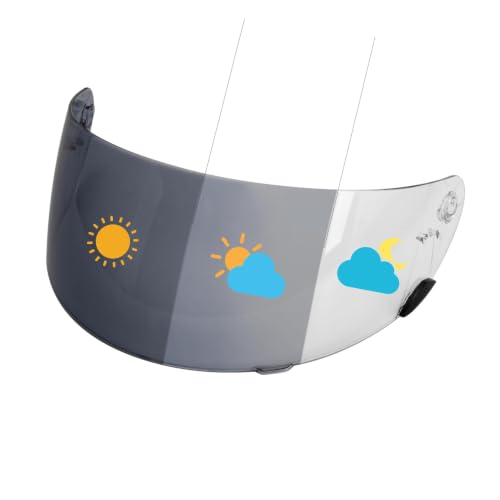
Best for riders who want a single shield that covers day and night without swapping visors. The PSLER Qualifier visor is designed to fit Bell Qualifier/Qualifier DLX, Star, Vortex, RS-1, and Revolver helmets. Its tool-free installation supports quick, one-handed changes, ideal for riders who value speed and simplicity at the roadside. The visor uses photochromic technology, remaining crystal clear indoors and darkening automatically in sunlight, reducing glare and the need to carry multiple shields. It’s built from high-strength polycarbonate to resist impact, making it a solid option for daily commuting and sport riding. A notable caution is the electroplating process that can show staining over time and may require careful bug-stain removal to prevent long-term marks.
- Best for: Day-to-night use on compatible Bell Qualifier family helmets.
- Better for: Riders who want a single shield for both conditions without manual changes.
- Caution: Fitment can vary; some minor gaps or noise leakage may occur due to non-OEM sizing.
WeePro Photochromic Anti-Fog Helmet Visor Film

This entry is a cost-conscious option that lets riders add a photochromic layer directly to an existing visor. The film darkens in bright sun and returns to clear in lower light, with performance adjusting to UV intensity. It’s especially convenient for motorcyclists who don’t want to invest in a new shield. Installation is straightforward and designed to be adhesive-edge sealed, offering a painless upgrade. The transition is gradual and not instantaneous, which may affect riders who need immediate darkness in sudden sun exposure.
- Best for: Budget-minded riders who prefer a DIY tint upgrade inside the helmet visor.
- Better for: Those who want to avoid extra visors or sunglasses.
- Caution: Transition speed is gradual; may not satisfy riders needing instant darkening.
PSLER RF-1400 Photochromic Visor for RF1400 Series

Targeted at RF1400, X15, and related models, this visor supports day-to-night use for a defined set of helmet configurations. It darkens with UV exposure, returning to transparency indoors. The dataset notes the electroplating process used on the X15 and warns that bug residues can degrade the finish over time. This visor is best for riders who have a compatible RF1400/X15 family helmet and want a dedicated, model-specific intake of photochromic function. Choose this if you ride mainly in daylight but want reliable night performance on compatible gear.
- Best for: RF1400/X15/NXR2/CWR-F2R users seeking model-specific fit.
- Better for: Riders who prefer a dedicated visor for their helmet family.
- Caution: Electroplating layer may be sensitive to bug splatter; maintenance is advised.
The Helmet Shop HJ-31 Photochromic Visor for i10 & i70

The HJ-31 visor is described as a universal, direct-fit replacement designed for i10 and i70 helmets, with a polycarbonate body and UV protection for clarity across conditions. It emphasizes an edge seal to minimize wind noise and improves overall comfort. It ships with anti-fog-ready features and compatibility with post inserts for fog management. The shield is noted as not compatible with some competing models, so compatibility verification is essential. Best for riders who want a reliable, optically corrected shield with anti-fog options.
- Best for: i10/i70 helmet users seeking a universal, reliable upgrade.
- Better for: Those who want anti-fog-ready performance with a clean seal.
- Caution: Not compatible with CL-31, i31, or RPHA 31 series helmets.
Shoei CWR-F2 Transitions Pinlock Shield

The Shoei CWR-F2 shield combines transitions technology with Pinlock-ready protection, offering automatic adaptation to light conditions and a high-clarity, distortion-free surface. The design includes venting considerations and Vortex-inspired aerodynamics for quieter rides. It is best for Shoei riders who want a seamless, integrated transition visor and UV protection in a single shield. A limitation is that this is a model-specific shield and may not fit non-Shoei configurations without adapters or additional parts.
- Best for: Shoei helmet owners prioritizing automatic transitions and UV protection.
- Better for: Riders who value premium visibility and reduced wind noise.
- Caution: Model-specific fit; check compatibility before purchase.
PSLER Sedici Strada 2 Visor

This visor fits Sedici Strada 2 and Strada 3 families, including FF801 and FF397, and is marketed as an aftermarket option. It is presented as a day-to-night solution with electroplating considerations similar to other PSLER visors. It comes with a note about possible gaps or noise leakage due to non-OEM fit. The service promise mentions a free replacement within three months in some color options, contributing to added buyer assurance. Best for Sedici Strada owners seeking an aftermarket alternative with similar performance.
- Best for: Sedici Strada 2/3 helmet users seeking aftermarket visors.
- Better for: Those who want a replacement option with a short-term replacement policy.
- Caution: Fitment and gaps may occur; evaluate the helmet model notes carefully.
PSLER Qualifier Visor for Bell Qualifier Family

This replacement visor targets Bell Qualifier/Star/Vortex/RS-1/Revolver lines and emphasizes daytime use with non-OEM fit considerations due to the single-mold construction. The electroplating finish invites caution regarding insect residues and bug stains that can degrade the surface. It’s best for riders who own these Bell helmets and want an affordable, daytime-friendly replacement visor. A caveat is potential gaps or noise leakage caused by non-OEM curvature alignment.
- Best for: Bell Qualifier and related helmets needing a daytime-only shield.
- Better for: Budget-conscious riders seeking a straightforward replacement.
- Caution: Fitment is not guaranteed to be perfect on every unit; watch for gaps and noise.
Logto Photochromic Visor for R420

The Logto visor is positioned for R420-compatible helmets, offering auto-tinting with color options including clear to smoke and deep red or blue variants. It highlights fast transition in bright sun and automatic reversion in indoors settings, while noting that sun intensity, temperature, and riding position can influence transition speed. It’s a strong choice for riders who want a flexible, multi-color option to suit different riding styles and environments. A limitation is that photochromic behavior may vary under tunnels where lighting can affect visibility.
- Best for: R420-compatible helmets needing color transition options.
- Better for: Riders who want multiple tint choices beyond standard gray/clear.
- Caution: Transition performance can vary by environmental conditions.
Buying Guide: How To Choose A Transition Visor For Your Helmet
Key considerations help ensure you pick a visor that matches your helmet, riding style, and environment. Start by checking model compatibility, whether you ride primarily in daylight or night conditions, and how sensitive you are to immediate darkening in sudden sunlight.
- Compatibility and fit: Confirm that the visor is designed for your helmet model or family. Non-OEM fit can cause gaps, noise, or improper sealing.
- Photochromic performance: Look for a visor that darkens quickly enough for bright sun and returns to clear indoors. Note that performance varies with UV exposure, temperature, and riding position.
- Material and durability: Polycarbonate visors offer impact resistance and clarity. Electroplated finishes may require extra care to prevent staining from bug residue and cleaners.
- Installation: Tool-free or simple clip-on visors are ideal for riders who swap visors frequently. Consider the ease of one-handed operation for on-road changes.
- Anti-fog features: If you ride in humid or rainy conditions, an anti-fog system or post insert can improve visibility. Ensure compatibility with your visor model.
- Scope of use: Some visors are optimized for daytime use; others are explicitly designed for night riding. Choose accordingly to avoid glare or insufficient tint during dusk or dawn.
Frequently Asked Questions
- Do transition visors automatically adjust to all lighting conditions? Most adapt to sunlight via photochromic or UV-sensing technologies, but performance can vary by temperature and light intensity.
- Are transition visors compatible with all helmet brands? Compatibility is model-dependent. Verify fitment with your helmet’s maker or use the product’s compatibility notes.
- Can I install a transition visor myself? Many visors are designed for easy, tool-free installation, though some require professional mounting or careful alignment.
- Will a transition visor fog less than a standard visor? Some visors include anti-fog features or inserts; these help but do not guarantee fog-free performance in all conditions.
- Is a transition visor suitable for night riding? Yes, most are clear indoors and darken in sun; ensure you have appropriate performance for night visibility as some may remain slightly tinted under certain light levels.
- Do I need to replace the visor when switching helmets? If your helmet model differs, you may need a different visor designed for that model to ensure fit and seal.