Best Trickle Chargers for Cars: Top Picks for Maintenance and Longevity 2026
Answering the need for reliable car battery care, these trickle chargers and maintainers keep batteries topped off and ready. They suit most 6V/12V lead-acid and some lithium batteries, with compact designs, automatic maintenance, and temperature compensation. Best for weekend drivers, classic car owners, and boaters who store batteries seasonally. Below is a quick buyer table, followed by detailed product insights.
| Product | Type | Best For | Key Benefit |
|---|---|---|---|
| NOCO GENIUS1 | 1A, 6V/12V | Basic maintenance, small batteries | Compact, versatile, automatic desulfator |
| NOCO GENIUS2 | 2A, 6V/12V | Mid-size batteries, faster maintenance | Powerful, energy-efficient, force mode option |
| NOCO GENIUS5 | 5A, 6V/12V | All-around charger and maintainer | Higher power, compact form, desulfator |
| NOCO GENIUS10 | 10A, 6V/12V | Larger leads-acid or LiFePO4 batteries | High current, robust for larger batteries |
| NEXPEAK 2-Pack | 4-in-1, 6V/12V | Budget-friendly, multiple vehicle needs | LCD display, multistage charging, desulfator |
NOCO GENIUS1: 1A Trickle Charger and Maintainer

Best for: Small batteries and light maintenance routines. This model combines a battery charger, maintainer, desulfator, and temperature-compensated control in a compact unit. It supports lead-acid types (including flooded and maintenance-free) and LiFePO4 lithium batteries, making it a versatile choice for motorcycles, small cars, and seasonal storage. The integrated thermal sensor adjusts charging to ambient temperature, reducing the risk of overcharge in heat and insufficient charge in cold weather. Caution: its 1A output means slower recovery for deeply discharged packs.
NOCO GENIUS2: 2A Smart Charger and Maintainer

Best for: Everyday use with faster maintenance than GENIUS1. GENIUS2 adds more power while remaining compact, suitable for most 6V/12V lead-acid and LiFePO4 batteries including marine and deep-cycle varieties. It features a Force Mode to bypass sensing and re-charge deeply discharged packs, which helps when a battery has been stored for an extended period. Limitation: higher power draw than GENIUS1, so it’s best paired with a compatible battery setup and a stable charging environment.
NOCO GENIUS5: 5A Smart Charger and Maintainer
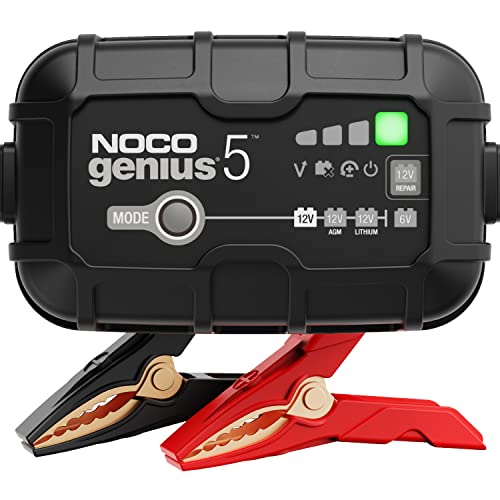
Best for: Medium to large batteries or when you need faster maintenance while keeping a trickle charging option. GENIUS5 delivers more than double the power of GENIUS2 and maintains automatic protection with temperature-based adjustment. It supports a broad range of 6V/12V lead-acid and LiFePO4 batteries, including marine and deep-cycle models. Caution: higher current means it may be less suitable for very small batteries if not used carefully.
NOCO GENIUS10: 10A Smart Charger and Maintainer

Best for: Larger 6V/12V batteries or fleets that require robust charging power. GENIUS10 provides a high 10A output while still offering automatic maintenance, desulfation, and temperature compensation. It handles both lead-acid and LiFePO4 chemistry, including flooded and deep-cycle types. Advantage: faster recovery and charging for bigger batteries. Limitation: bulkier unit with higher energy use, not ideal for very small or compact battery setups.
NEXPEAK 2-Pack 6V/12V Battery Charger Maintainer
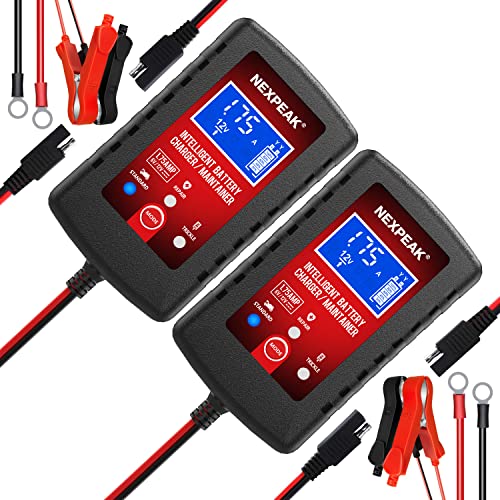
Best for: Budget-conscious buyers needing multiple units for several vehicles. This 4-in-1 charger maintains 6V/12V lead-acid batteries with LCD display showing voltage, charge level, and current. It includes a seven-stage charging program with desulfation steps and trickle charging. The two-pack option helps manage multiple vehicles or seasonal storage. Caution: the LCD display is helpful, but overall feature depth is lower than higher-end NOCO models.
Buying Guide
What to consider before buying a trickle charger for cars:
- Battery chemistry: Most units support lead-acid varieties; ensure LiFePO4 compatibility if you use lithium batteries.
- Charging current: Choose 1A–2A for small batteries and daily maintenance; 5A–10A for larger batteries or faster top-offs.
- Temperature compensation: Thermally aware charging helps prevent overcharging in heat and undercharging in cold.
- Maintenance vs charging: Some models are primarily for maintaining a full state, others offer desulfation to improve lifecycles.
- Display and usability: LCD screens provide real-time status; consider if you prefer tactile controls or automated operation.
- Safety features: Overcharge protection, reverse polarity protection, and smart sensing reduce risk during storage or use.
- Portability and size: Smaller units fit tight spaces; larger models suit garages with stable power access.
FAQ
- What is a trickle charger used for? It maintains a battery at full charge over time, preventing self-discharge during periods of inactivity.
- Can I use a trickle charger on LiFePO4 batteries? Yes, if the charger specifies LiFePO4 support; otherwise follow the manufacturer’s guidelines.
- Is it safe to leave a charger plugged in overnight? Most modern smart chargers are designed for continuous maintenance, but always follow the product manual.
- What’s the advantage of a higher current charger? Higher current speeds up charging for larger batteries but may generate more heat and require appropriate wiring and space.
- Do I need a desulfator? Desulfation can help restore some older lead-acid batteries, but its effectiveness varies by battery condition.
- Should I use the charger with a boat or marine battery? Yes, provided the unit supports marine and deep-cycle battery types and is rated for the expected charging profile.