Best Water Pumps for Trailers: Reliable RV Fresh Water Pumps for 2026
Need a dependable water pump for your trailer or RV? This guide compares five top options designed for on-demand fresh water supply, with clear notes on who each pump suits best. Whether you’re RVing, camping, or living off-grid, select a pump that matches your water needs, power source, and installation constraints. The table below highlights key specs to help you compare at a glance.
| Product | ||||
|---|---|---|---|---|
| ECO-WORTHY 33-Series Industrial Water Pressure Pump | 110V AC | 4.0 GPM | 45–70 PSI (adjustable) | Higher-demand RV setups; fixed AC power |
| ECO-WORTHY RV Fresh Water Pump 12V DC | 12V DC | 3.5 GPM | 35–80 PSI (adjustable) | Off-grid RVs; battery-powered flexibility |
| SEAFLO 33 Series 110V/115V | 115V (and 110V variants) | 3.3 GPM | 45 PSI | Long-term reliability for RVs and boats |
| WASSERMANN RV Pump, 12V | 12V DC | 4.0 GPM | 45 PSI | Complete kit; versatile 12V power |
| [Upgraded Version] MRGVFLO 12V DC | 12V DC | 7.0 GPM | 70 PSI | High-demand water systems; quiet, five-chamber design |
Note: The table summarizes the five selections below. Each product includes a self-priming diaphragm pump and an on-demand pressure switch, with variations in power source (AC vs. DC) and flow rate. Use the buying guide for details on choosing the right match for your trailer setup.
ECO-WORTHY 33-Series 110V Diaphragm Pump
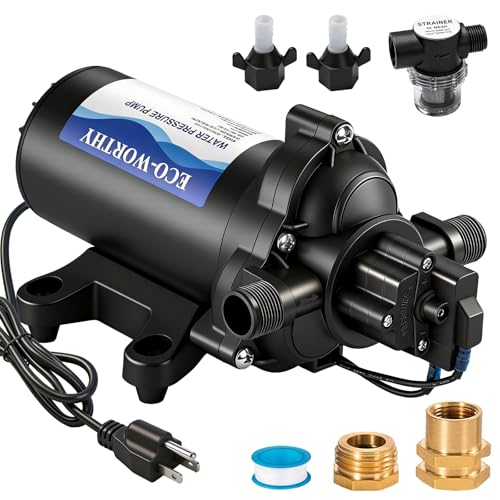
The 33-Series is a 110V AC diaphragm pump with a 4.0 GPM flow and 50 PSI operating threshold, featuring a smart pressure switch and quiet operation. It self-primes up to 9.8 feet and can lift water up to 131 feet, making it suitable for trailers with higher elevation or longer hose runs. An adjustable pressure range from 45 to 70 PSI supports varied fixture demand. It includes thermal overload protection for motor safety during use. Best for campers or motorhomes connected to a standard AC power source who need steady, moderate flow with automatic on-demand control.
Best for: RVs with onboard AC power and higher water demands. Better for: setups where you want a robust, fixed-power solution with a wide operating range. Caution: The motor will shut off if temperatures exceed 203°F, so ensure adequate ventilation and avoid overheating on hot days.
ECO-WORTHY RV Fresh Water Pump 12V DC

This 12V DC pump provides 3.5 GPM with a 45 PSI switch setting. It offers self-priming up to 9.8 vertical feet and supports an adjustable pressure range of 35–80 PSI. The manufacturer includes a thermal overload protection feature and a dry-run capability to minimize damage when water supply is momentarily unavailable. Best for: off-grid RVs or campers relying on battery power. Caution: Intended for use with standard 12V battery systems; avoid rapid cycling to extend life.
SEAFLO 33 Series 3.3 GPM Fresh Water Pump

Model SFDPA1-033-045-33 offers 3.3 GPM at 45 PSI, with a 12V cut-off or 115V supply variant. It is self-priming and designed for RVs, caravans, boats, and industrial use. The pump is NSF/UL listed to meet potable water standards and comes with a four-year warranty, ensuring long-term reliability. Best for: users who require NSF/UL-compliant potable water performance and long-term warranty. Caution: Verify compatibility with your electrical system (12V vs. 115V) before purchasing.
WASSERMANN RV Pump, 12V 4.0 GPM

This 12V DC pump delivers up to 4.0 GPM at a steady 45 PSI and is sold as a complete kit with hoses, adaptors, a filter, and user manual. It is compatible with standard 12V battery power and can be mounted in RVs, campers, or small boats. Best for: users wanting a ready-to-install package with all necessary fittings. Caution: Check hose compatibility with your fixtures to avoid leaks around fittings.
MRGVFLO Upgraded 12V Fresh Water Pump
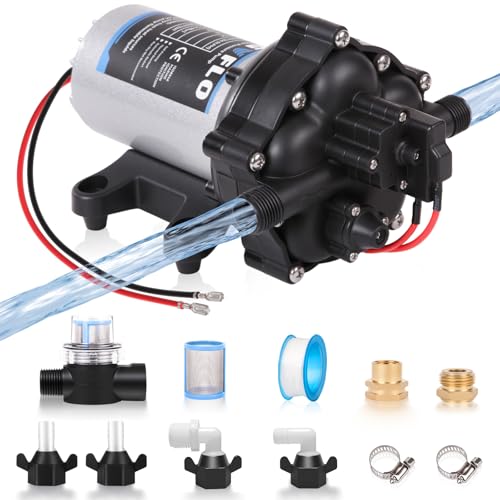
Upgraded version features a five-chamber diaphragm with a maximum of 70 PSI and a rated 7.0 GPM flow. It includes a smart pressure switch for automatic on/off and is designed for quiet operation and energy efficiency. Best for: higher-demand trailer systems needing robust flow and stronger pressure. Caution: Requires a suitable 40A fuse and proper wiring to avoid overloading the circuit.
Buying Guide
What power source fits your trailer?
Choose AC-powered pumps (110V/115V) if your trailer has a dedicated AC generator or shore power. DC pumps (12V) are ideal for off-grid setups relying on battery banks. Some models offer dual-power compatibility; match your power availability to avoid running gear or wiring updates.
How much water do you need?
Assess your daily water usage and fixture count. Higher GPM (gallons per minute) and PSI ratings support multi-fixture usage, like showers and sinks simultaneously. For frequent showers and longer stays, prefer pumps around 4–7 GPM with 45–70 PSI. For simple cabin lines, 3–4 GPM often suffices.
Installation and maintenance considerations
Look for self-priming capability, thermal overload protection, and dry-run tolerance to prevent motor burnout. Ensure compatible fittings (1/2″ or 3/4″ hoses) and consider the availability of install hardware in the kit. Some pumps include complete accessory sets, which reduces compatibility concerns.
Portability and noise
Diaphragm pumps are typically quiet, but mounting and vibration dampening can reduce operational noise. If noise is a concern in compact trailers, prioritize models with built-in dampening or better mounting solutions.
Frequently Asked Questions
- What is the difference between 110V and 12V RV pumps? 110V pumps require shore power or a generator and usually deliver consistent flow. 12V pumps run off the battery, offering portability but may have lower peak performance.
- Do these pumps require priming? Most self-priming diaphragm pumps can lift water from a small reservoir, but priming may help initial startup in some installations.
- Is a higher PSI always better? Not necessarily. Choose PSI based on your fixtures and hose length; too high pressure can stress fittings and cause leaks.
- Can I run a pump without a tank or water source? Dry-running can damage some models. Look for dry-run protection or avoid starting the pump without an available water source.
- Do these pumps come with installation hardware? Some kits include hoses, adaptors, and filters. Verify what’s included before purchase to ensure full compatibility with your rig.